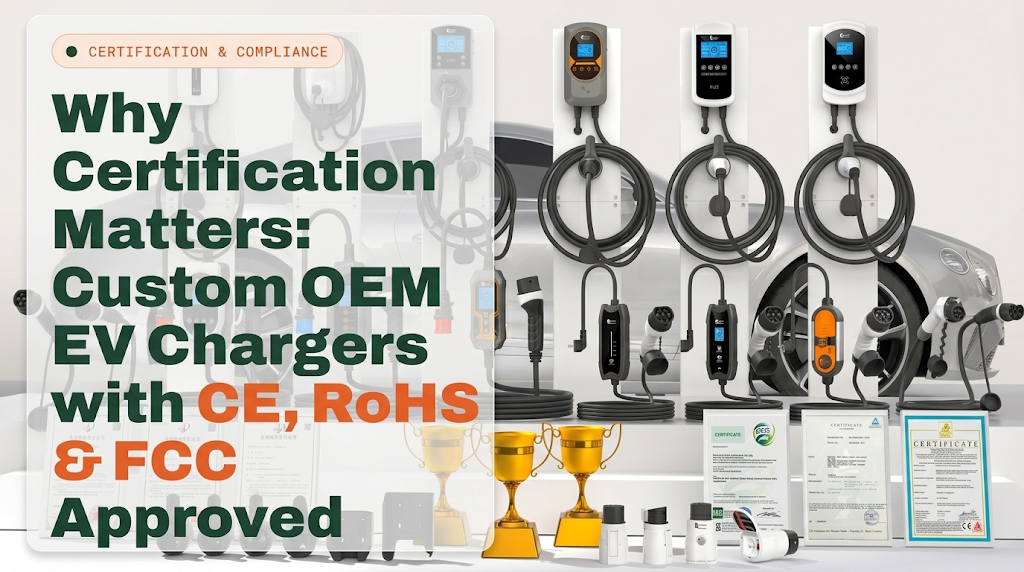
 A market-access framework for OEM buyers — how four certification dimensions determine whether a single charger design can ship to Europe, North America and beyond without redesign at the border.
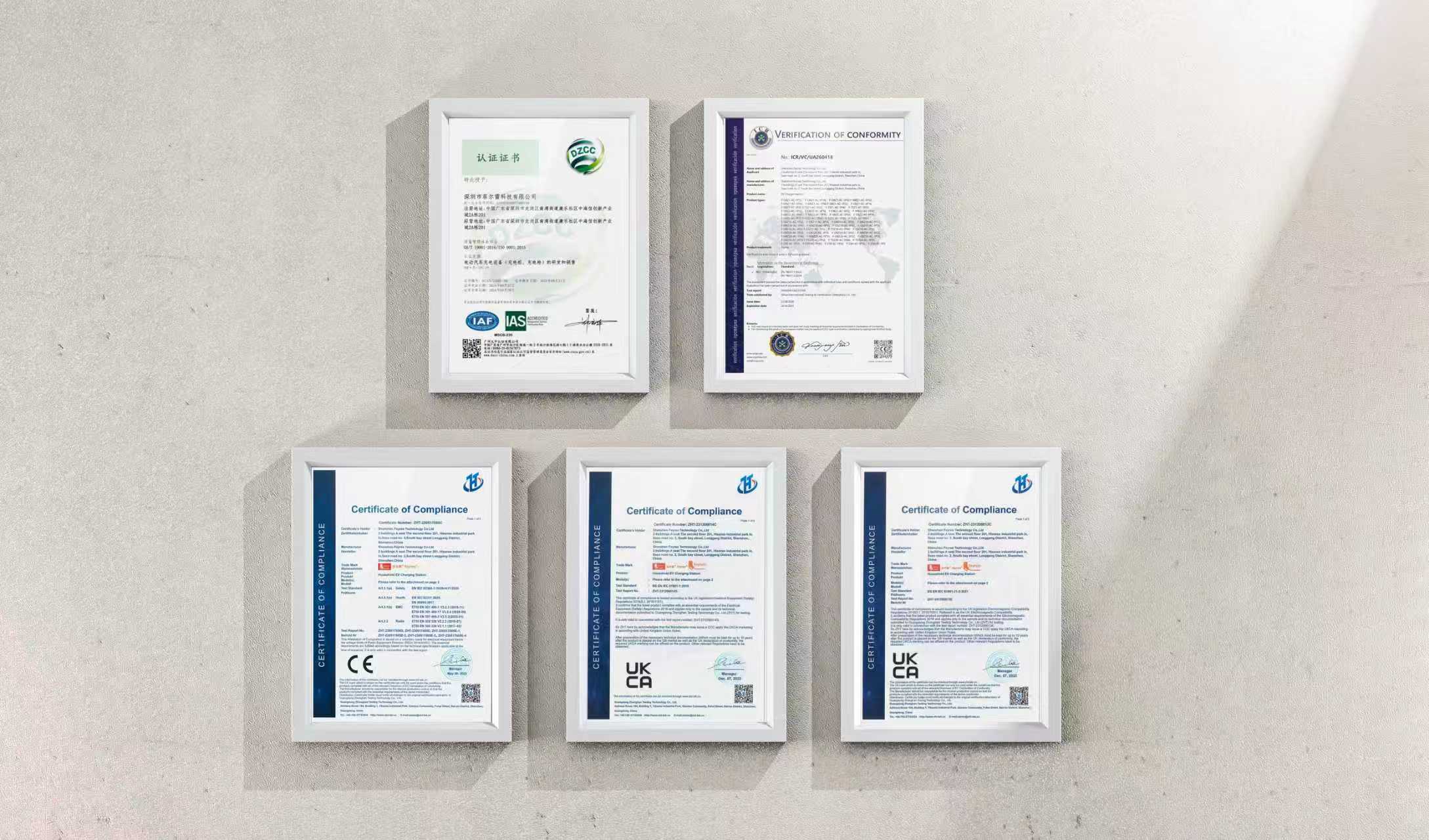 Feyree's OEM charger lineup, backed by patent certificates and third-party test documentationFIG. 01
As EV adoption continues to grow worldwide, regional markets are steadily establishing their own regulatory requirements. For OEM buyers, the ability to sell the same product across multiple markets in full compliance is critical. Whether a custom OEM EV charger can be sold across European, North American, and UK markets without modification at each border depends on the certification portfolio the manufacturer integrates into its design and production process.
Four dimensions that determine market access
For OEM buyers sourcing custom EV chargers, these four dimensions — evaluated together, not in sequence — form a framework for assessing any supplier's true market-access capability.
Safety certification
CE marking and TÜV testing verify electrical safety, low-voltage operation, and electromagnetic compatibility — the baseline documentation distributors and regulators expect.
Environmental compliance
RoHS certification confirms restricted hazardous substances — lead, mercury, cadmium and others — are eliminated from materials and manufacturing, required for the EU market.
Electromagnetic compatibility
FCC approval demonstrates the charger doesn't emit interference that could disrupt nearby electronics — a mandatory step for entering the North American market.
Process-embedded certification
Rather than a final-stage label, certification is built into product development, so each custom design arrives with its target market's documentation already in place.
Feyree's custom OEM EV chargers cover all four dimensions — each backed by verifiable documentation from accredited third-party laboratories, supporting distribution across North America, Europe, and beyond.
CE and TÜV — European market entry
For OEM buyers targeting Europe, CE marking and TÜV certification form the baseline safety credentials that distribution partners and regulators expect. The two work together across three dimensions:
CE marking under the Low Voltage Directive and EMC Directive confirms the charger meets EU/EEA legal requirements. TÜV certification for cable components adds independent verification by German-accredited labs, testing beyond CE's self-declaration.
As part of the CE framework, chargers integrate Type B residual current protection (AC 30 mA and DC 6 mA) — the level required for EV charging equipment under European installation standards.
Certificates are issued by accredited third-party laboratories, not the manufacturer. Each carries a unique reference number, verifiable through the issuing body's database.
RoHS — environmental compliance
The Restriction of Hazardous Substances (RoHS) directive limits lead, mercury, cadmium, hexavalent chromium, and two classes of brominated flame retardants in electrical equipment placed on the European market. For custom OEM chargers, compliance is verified through material declarations and sourcing records — not product-level testing alone.
Feyree specifies 100% lead-free PCB manufacturing and selects component suppliers that provide RoHS-compliant certification documentation from the outset.
The charging cable uses TPU (thermoplastic polyurethane) insulation — RoHS-compliant while delivering the flexibility, UV resistance and abrasion performance daily charging demands.
Environmental compliance is folded into material selection alongside performance specs, so certified chargers keep the same mechanical and electrical properties as standard production units.
FCC — accessing the North American market
For OEM buyers distributing in the US and Canada, FCC approval is mandatory — it verifies the charger doesn't generate electromagnetic interference that could disrupt nearby electronics. Certification tests radiated and conducted emissions against FCC Part 15 limits.
Wide compatibility: single-phase 85 V–264 V and three-phase 160 V–450 V, supporting both 50 Hz and 60 Hz.
Adjustable from 8 A to 32 A, aligning with North American residential and commercial electrical configurations.
OEM buyers can reference the FCC ID on each certified product to verify approval status directly through the FCC database.
Integrating certification into OEM development
Certification isn't a final-stage label applied after production. Feyree's OEM program embeds third-party testing into a structured four-stage development process:
Consultation & requirements
The engineering team studies the client's target market and identifies the certification combination required — CE, TÜV, RoHS, FCC, UKCA, or others — before design work begins.
Design & prototyping
Industrial design, PCB engineering, firmware development, and enclosure prototyping are handled in-house, with certification requirements factored into material, circuit and enclosure choices from the start.
Certification & testing
Feyree coordinates all required third-party testing through accredited laboratories, so the finished product arrives with its target market's regulatory documentation already in place.
Production & after-sales
Mass production with full QC, on-time delivery, and dedicated technical support for the product's lifecycle. Certificate copies are maintained for customs clearance and distributor qualification throughout the run.
In addition to third-party certifications, Feyree holds multiple design and utility patents registered with China's National Intellectual Property Administration, covering aspects of product design and charging technology that complement the certified safety and performance baseline.
A faster path from approval to market
For OEM buyers sourcing custom EV chargers, a well-documented certification portfolio means a faster path from production approval to market availability. By embedding third-party certification into product development rather than adding it afterward, Feyree ensures each custom OEM project arrives with the regulatory documentation its target market requires.