Tap-to-Charge: The Logic Behind a Simple Card Tap
Hold a card near the reader, and a few seconds later the station lights up and power begins flowing. What looks like a trivial gesture is actually a coordinated handshake between a card reader, a charging station, and a backend system.
Where tap-to-charge shows up
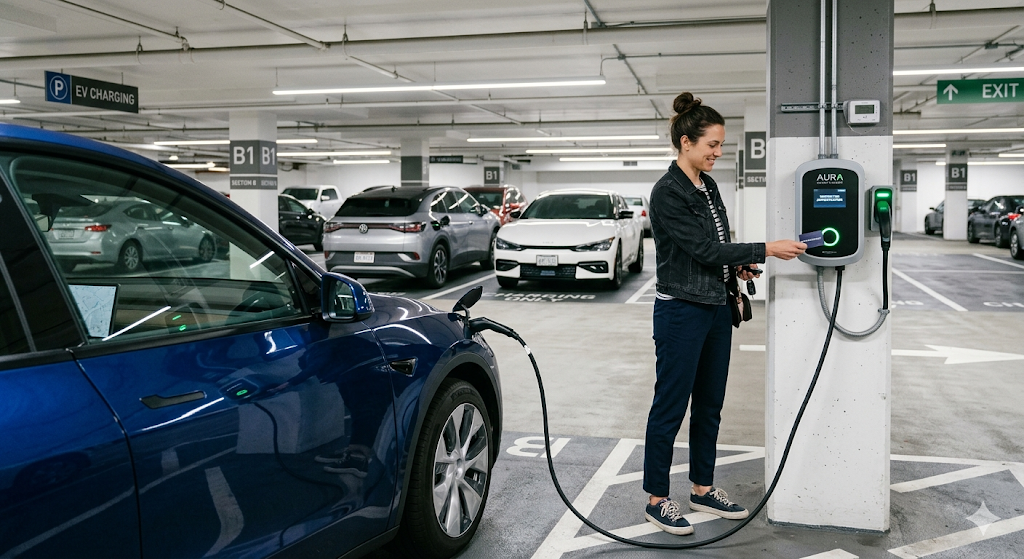
Imagine this scene: you park your car in a residential parking space or at your company's parking lot, hold a card near the charging station's reader, and a few seconds later the station lights up and charging begins. This is what many people mean by "tap-to-charge." It looks simple: commuters start charging with a card in the morning, and homeowners can begin charging with a single tap when they get back home. But behind this simple action is a clear process and several different types of cards, each affecting convenience, security, and management in different ways.
In residential settings, residents often use a card or a tag provided by the property manager and keep it on a key ring, so they can simply tap their dedicated charger when they get home. This setup usually prioritizes simplicity and stability. In company or fleet environments, businesses assign dedicated chargers to specific vehicles, and employees or designated vehicles use company-issued cards, which makes billing and access control easier. At public fast-charging or commercial stations, some operators support both physical cards and NFC on mobile phones, allowing for faster payment and user identification. These scenarios shape the system's priorities: residential and corporate charging tend to value offline availability and access control, while public stations care more about online payment and security.
What actually happens when you tap
Tap-to-charge actually depends on the cooperation of three parts: the card reader on the station, the charging unit itself, and the backend management system that handles verification and billing. The process works as follows.
Technically, the communication between the reader and the backend should be encrypted, such as through TLS. Cards may be verified online or allowed through a locally stored whitelist, and NFC on mobile phones often uses tokenization and secure elements to protect credentials. In other words, what looks like a simple tap actually involves identification, verification, authorization, metering, and settlement.
Not all cards are the same
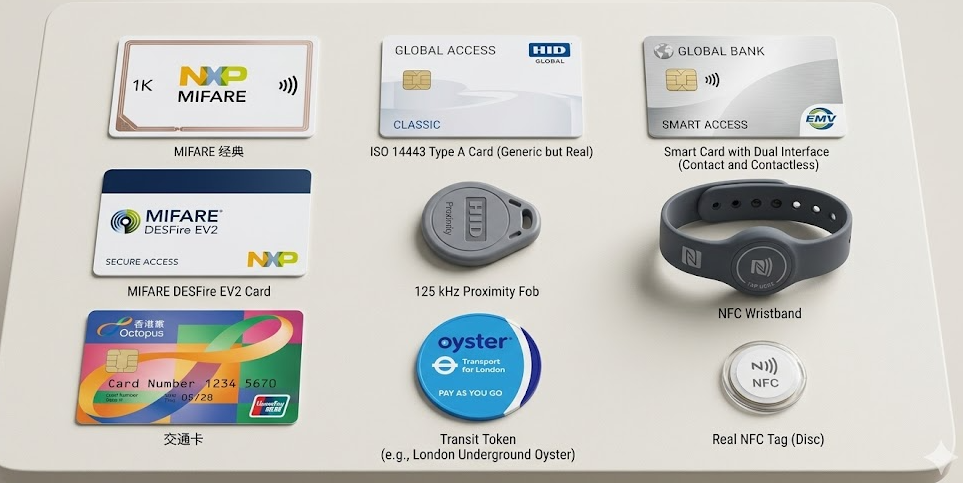
When people talk about "cards," they are not referring to just one kind. The same "tap" gesture can involve quite different technology underneath:
| Type | Frequency | Security | Best for |
|---|---|---|---|
| Classic RFID | 125 kHz | Low | Low-cost private setups where security requirements are low |
| MIFARE | 13.56 MHz | Medium | Residential communities or company-managed charging; supports segmentation and basic authentication |
| DESFire / high-security | 13.56 MHz | High | Public fast-charging or commercial billing environments; stronger encryption and key management |
| Mobile NFC | 13.56 MHz | High | Replacing the physical card; depends on the phone's security module and tokenization |
NFC is a form of high-frequency RFID, and more users are now linking their card information to phones or digital wallets, allowing them to tap a phone instead of carrying a physical card. This adds a great deal of convenience, while depending on the phone's security module and tokenization to protect credentials.
Security and management challenges
Any card-based system faces challenges in security and management. Low-frequency cards are easier to copy, and older readers or unencrypted communications can increase the risk of interception or man-in-the-middle attacks.
- Phase out easily cloned cards
- Adopt high-security cards with key management
- Encrypt communication between readers and the backend
- Implement key rotation and firmware signing
- Keep physical cards safe; report lost cards immediately
- Enable mobile binding whenever possible
- Turn on consumption notifications to spot unusual activity quickly
The one-charger, one-card model
In most everyday situations, the process above and the choice of card type are enough to balance convenience and basic security. But when access needs to be tightly controlled, the system goes one step further: this is the "one charger, one card" model, where each charging station accepts only one specific card or a small set of designated cards. This approach is common for dedicated home chargers, company parking spots, or other highly sensitive usage scenarios.
Technically, it is usually implemented by writing the allowed card IDs into the station's local whitelist or by having the backend push and update the list regularly. In weak-network environments, the local whitelist allows offline authorization; when the network is available, the backend can push updates or revoke access immediately, enabling more flexible management. To avoid single-point failures or problems caused by lost cards, real deployments often include backup cards, remote authorization, temporary QR codes, or license-plate recognition as fallback options.
The reason a station is set up to correspond to only one card is actually quite simple: it allows more precise control and ensures that dedicated parking spots or charging stations are not used by unauthorized vehicles. For company executive parking spaces, fleet chargers, or private residential chargers, this approach makes usage relationships clearer and reduces management confusion. For users, the operation is straightforward: tap the authorized card, and the station responds immediately, without requiring an app login or online payment each time, which makes the experience smoother. Even more importantly, this model remains stable in places with poor network coverage, because the station usually stores the whitelist in advance, so it can still verify access locally without being affected by temporary communication problems.
Standard RFID vs. charger-card matching: what's different
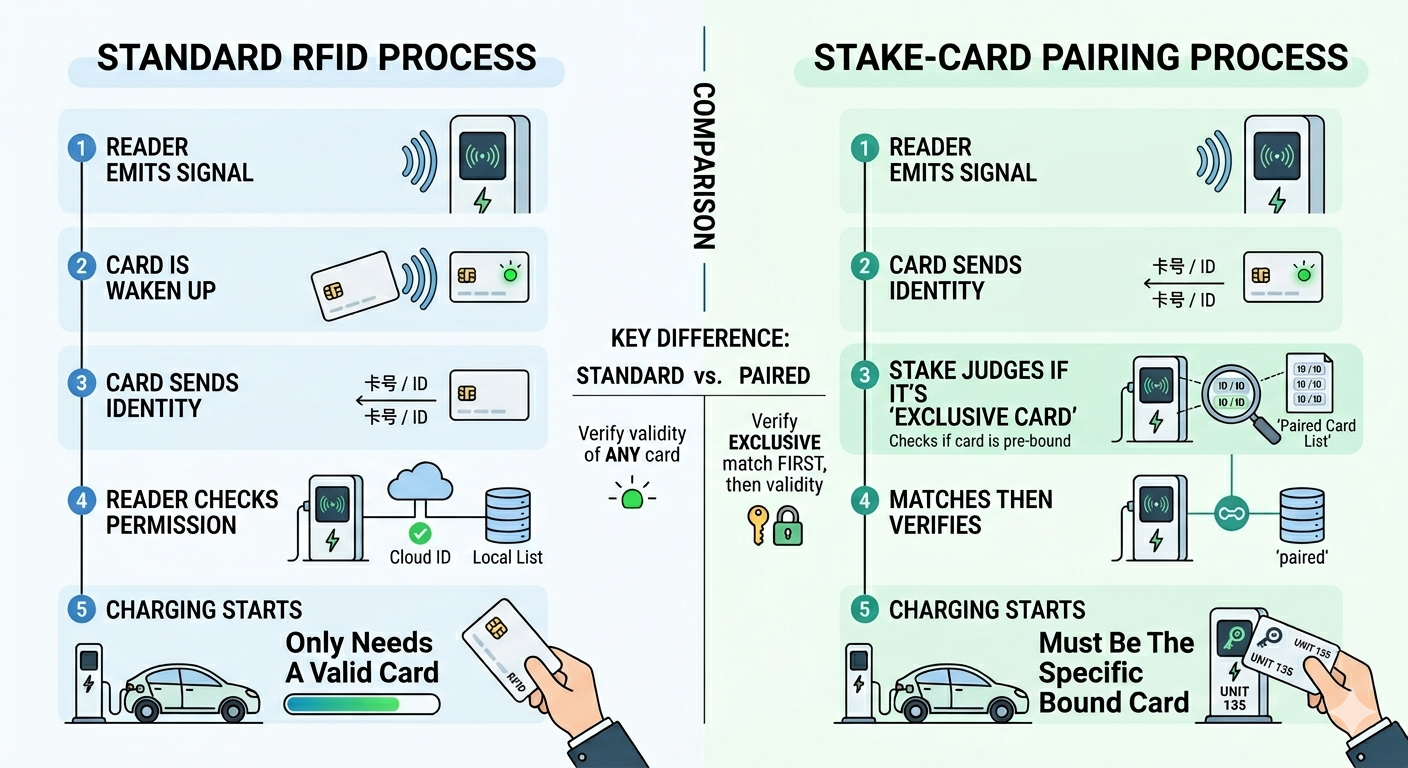
Compared with ordinary RFID, charger-card matching involves one additional decision step. In a normal RFID system, the relationship between the card and the station is mainly about identity verification. Once the card approaches the reader, the reader wakes the card up, reads the card's unique number, and sends that number to the system to determine whether it is valid. The focus is on whether the card itself is authorized. If the card number is within the allowed range, the device usually accepts it. In that sense, it acts more like a general-purpose credential, and the reader is mainly trying to identify who the card belongs to.
In a one-to-one charger-card model, however, the logic is different. The system must not only determine whether the card is valid, but also whether the card is the one specifically bound to that charging station. In other words, it is not just "can this card be used," but "can this card be used on this particular device." That introduces a device-level binding relationship.
Acts more like a general-purpose credential. The reader checks: is this card valid? If the card number is within the allowed range, the device accepts it — like a pass that opens many doors.
Adds a device-binding layer. The station checks: is this card assigned to me specifically? Even a valid card is rejected without a pre-established binding — more like a dedicated key for one lock.
From a communication perspective, this difference is important. In a standard RFID scenario, once the card is awakened, it usually only needs to return a fixed ID, and the system checks that ID against a blacklist or whitelist. In a charger-card matching scenario, the card is not just saying "who I am"; the station also checks its own binding table to see whether this card has been paired with it in advance. If there is no binding relationship, even a valid card will be rejected. That means charger-card matching is not just identity verification, but identity verification plus device binding verification, which makes the process one step more controlled than ordinary RFID.
Technical content is for reference only. Evaluate against your specific deployment environment before making implementation decisions.